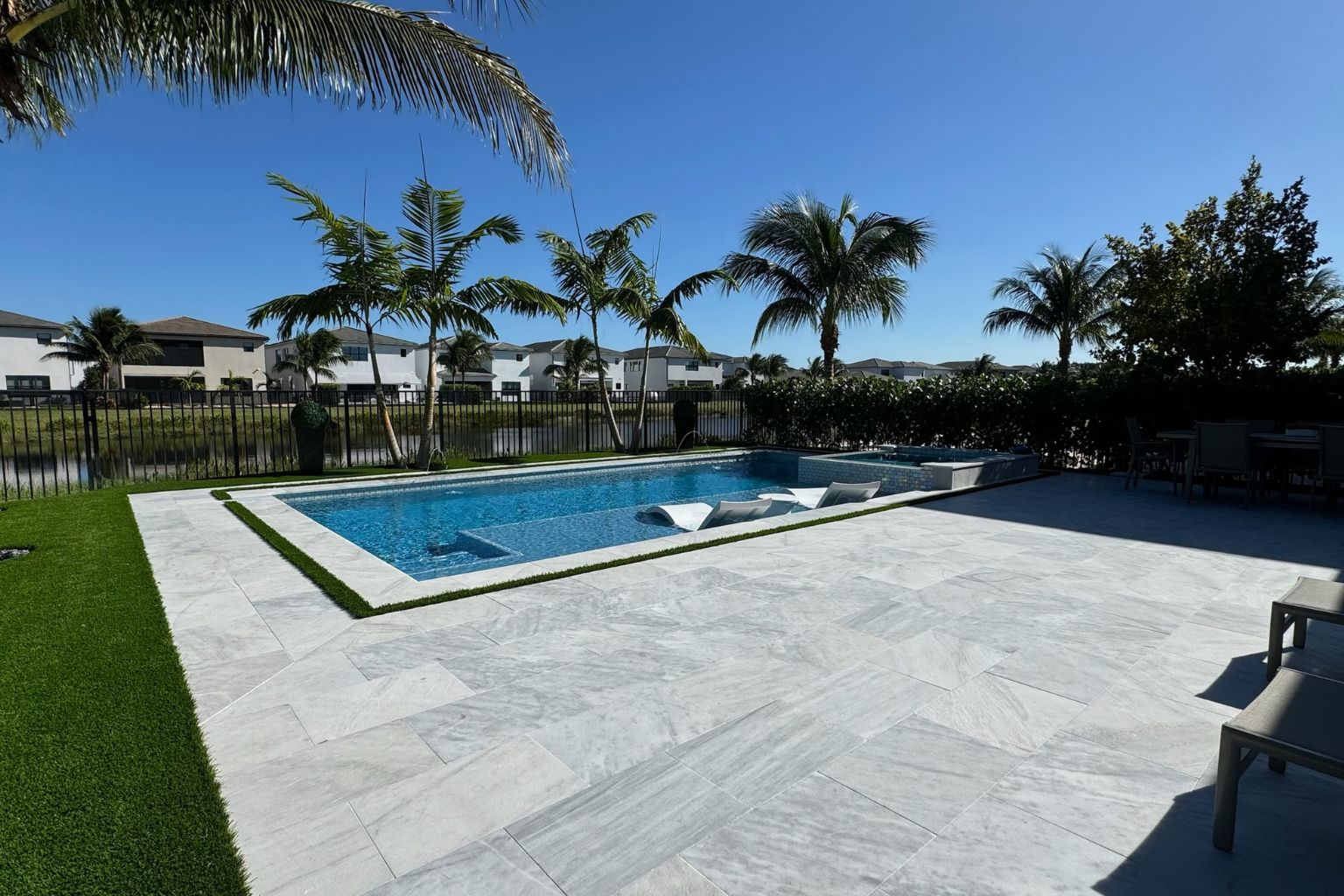

Your pool has a valve in its main drain that keeps the shell from lifting out of the ground when the water table rises. This valve, the height of the equipment pad, and the way screens and pergolas let wind through serve as built-in protections for your backyard. When it comes to hurricane pool prep, Florida homeowners can use this guide to cover the essential items to check ahead of the season, followed by a short preparation list once a storm receives a name.
M&M Pool Builders is a family-owned Boca Raton team with years of experience creating bespoke pools and outdoor living spaces throughout Palm Beach County. Drawing on local design expertise and a customer-first approach, the team helps homeowners plan resilient, well integrated backyards.
What Your Pool Already Has Built Into It
Builders install three specific components during construction that remain in place for the life of the pool. Since functioning components look identical to compromised ones from the deck, scheduling an inspection leading up to hurricane season is a good opportunity to verify everything operates correctly.
The Valve That Keeps Your Pool in the Ground
Keeping the pool full serves as the standard professional recommendation ahead of a storm. Your pool also features a built-in device that manages rising water tables and protects the shell.
A hydrostatic relief valve sits in the main drain at the deepest point of the shell. A perforated pipe laid in the gravel underneath the pool collects groundwater as the water table rises.
When the pressure of that groundwater climbs above the pressure inside the pool, the valve opens to let groundwater in. The two sides equalize, which neutralizes the upward force that could lift the shell. Since the valve works in one direction, a functioning unit holds your pool water where it belongs.
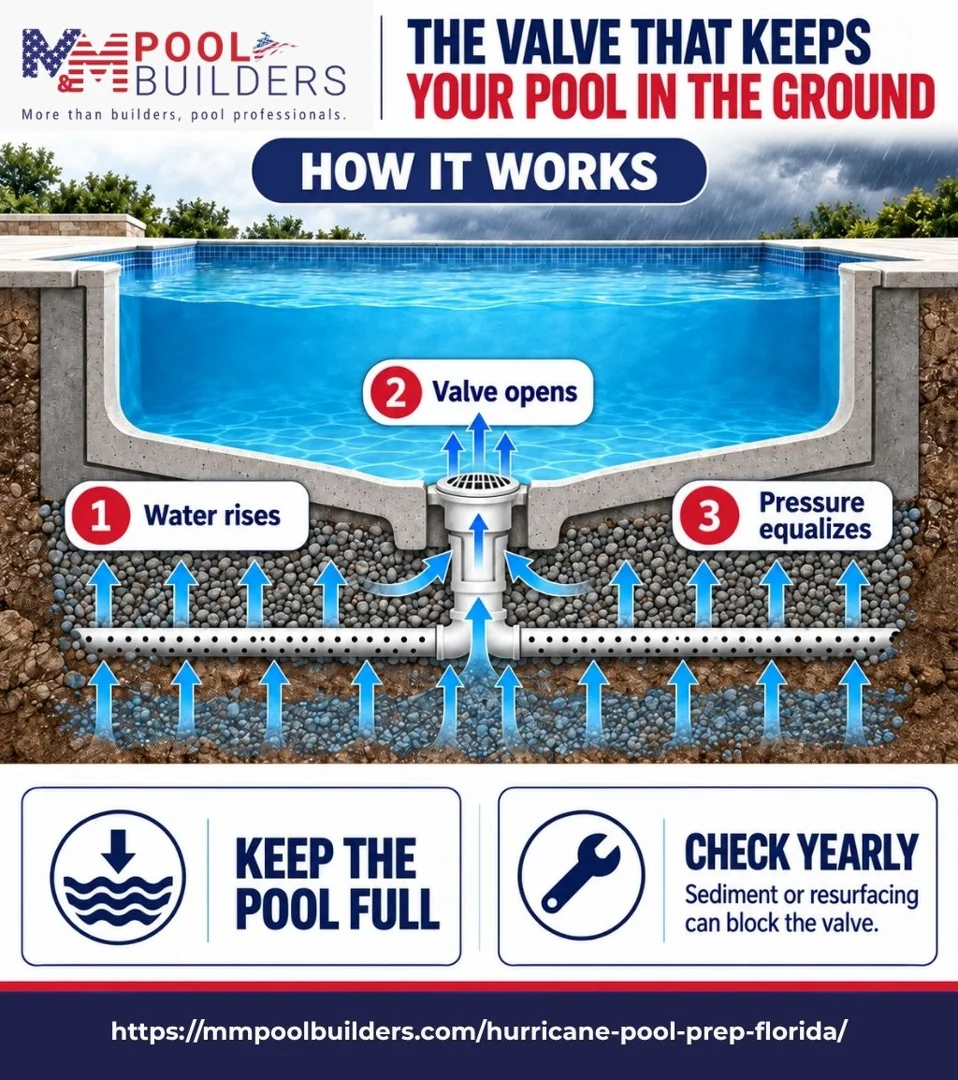
Three key details are worth knowing about your specific valve. Older pools occasionally feature designs omitting this component. Valves also collect sand and sediment over the years, requiring servicing to keep them moving.
A resurfacing project can cover a valve, leaving it unable to operate. These conditions remain hidden from the deck view, so checking the main drain belongs on your annual inspection schedule with a qualified professional.
How Your Pool Handles Rainfall on Its Own
A pool built with adequate overflow provision, working skimmers, and a deck that sheds water away from the house manages ordinary storm rainfall independently.
This capability stays important since many resources advise lowering the water level. The Florida Swimming Pool Association treats that recommendation as conditional. When a pool has working drains and skimmers alongside proper surrounding drainage, the water level can generally stay where it currently sits. Lowering the water by a foot or two is the remedy for yards where runoff might reach the house or damage surrounding structures.
The most useful step involves observing how your property handles drainage. By watching where water flows during an ordinary summer downpour, you can determine your yard’s drainage pattern ahead of a major storm.
The Bonding Grid Under Your Deck
Your pool equipment, handrails, ladders, and the steel reinforcing in the deck all connect to a common electrical potential. That bonding grid fulfills a code requirement, keeping everything around the water at the same voltage.
Storm debris, flooding, and equipment damage have the potential to interrupt that continuity. This makes the bonding grid a safety item, and a sensible addition to a post-storm inspection.
Where Your Equipment Pad Sits
Every storm checklist recommends wrapping the pump and cutting the power. The height of your equipment pad plays a major role in how you approach this step.
A pad set at grade in a low spot takes on water, while a pad raised on a poured platform above the yard’s typical water level usually stays dry. This difference comes down to a siting decision made during construction. That elevation choice determines whether you will spend time drying out motors following a significant storm or simply switching the breaker back on.
If your pad sits low, sandbagging around it ahead of a storm adds protection. If you plan to start a new build or a renovation, discussing pad height during the design phase is worth doing. Placing the pad well during initial construction saves considerable effort down the road.
The Structures Around the Water
A Boca Raton backyard features many elements beyond the pool itself. Each structure responds to wind based on its surface area. The guidance throughout this section emphasizes creating pathways for air to flow through. Screens, pergolas, turf, and summer kitchens each handle wind distribution differently.
Screen Enclosures
A structure that lets wind pass through it carries a light, manageable load. A solid structure carries the full force of the wind. The Florida Swimming Pool Association recommends creating a wind pathway out of an enclosed screen structure, and notes that removing panels on either side of the pool area vents the enclosure.
Retractable screens follow the same logical approach. An open screen allows wind to pass freely, so retracting the screens fully and securing the housing is the best strategy once authorities issue a storm watch.
Pergolas
Wind uplift affects pergolas, and the strong connection between the column and footing resists that upward force. Structures built to current Palm Beach County wind requirements are engineered specifically for that load.
For pergolas with adjustable louvers, opening them completely allows air to move smoothly through the structure. A closed louvered roof acts as a sail, directing wind force straight into the anchors. Keeping them open protects the entire installation.
Synthetic Turf
Synthetic turf drains at the rate its sub-base allows. A compacted crushed stone base moves water down and away quickly. Turf laid over less permeable base material retains water near the deck and the foundation. Ahead of a storm, taking time to sweep and open yard drains, gutters, and downspouts lets your existing drainage system do its job.
Summer Kitchens
Shutting the gas off at the meter or tank and unplugging all appliances secures the outdoor kitchen. Taking out grill grates, sear plates, and any movable items for indoor storage adds protection. Marine-grade stainless steel resists corrosion well, and covering the island with a strapped, wind-rated cover keeps debris off all surfaces. Our guide to modern outdoor kitchen ideas covers the material choices behind that durability.
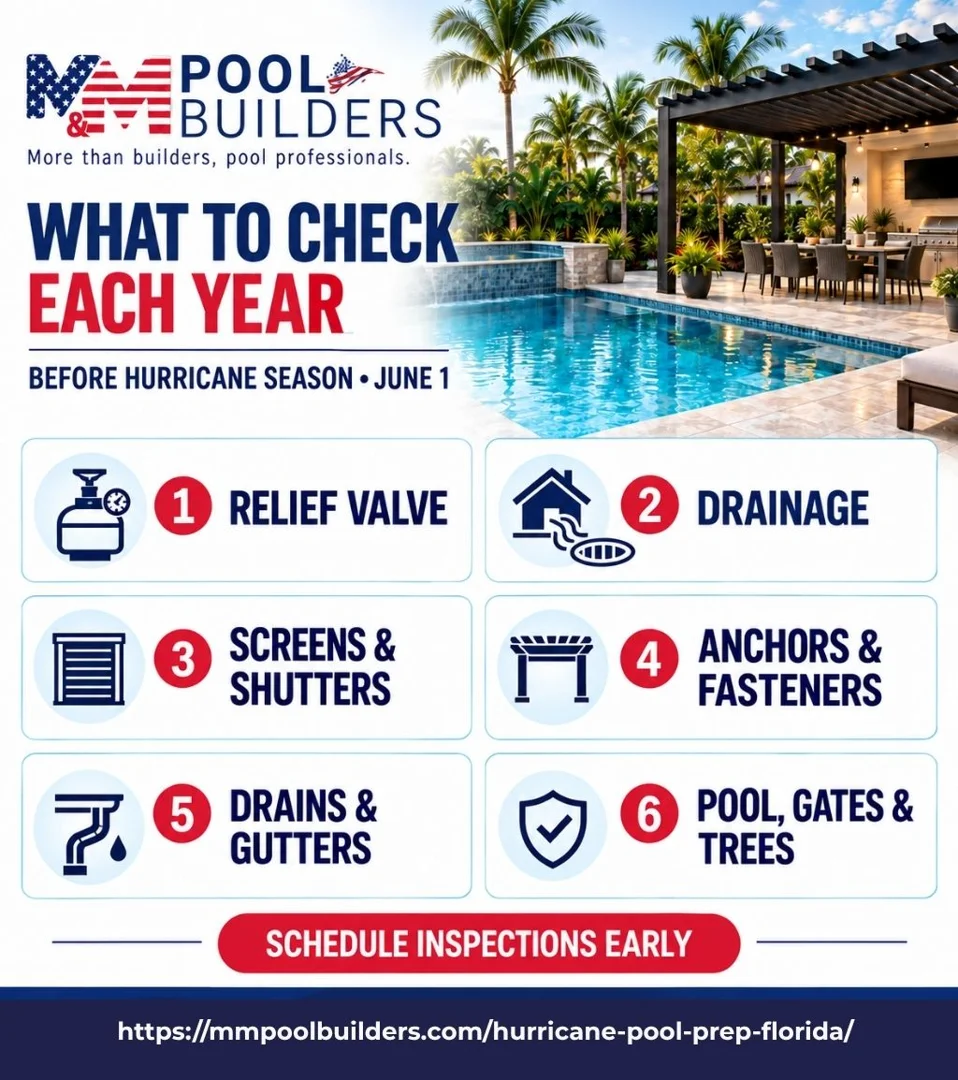
What to Check Each Year Ahead of June 1
Hurricane season runs from June 1 through November 30. The checklist below suits the quieter months at the start of the year, which makes it easier to schedule appointments with local professionals.
- Have a professional locate and check the hydrostatic relief valve, particularly on an older pool or one featuring a newer resurfaced finish
- Observe water flow during a heavy rain to confirm the deck and yard shed moisture away from the house
- Test every screen, shutter, and retractable system through a full cycle, taking time to lubricate the tracks
- Inspect pergola anchors and fasteners to confirm they remain secure and free of corrosion at the base
- Clean out all yard drains, gutters, and downspouts to promote proper water flow
- Review the pool shell, coping, and tile to confirm everything remains intact and free of separation
- Confirm all gates and safety barriers close and latch properly
- Hire an arborist to evaluate any trees within falling distance of the pool, screen, or deck
Completing these steps early means you only need to handle a brief preparation list when a storm appears in the forecast.
The Short List Once a Storm Is Named
With the annual preparation complete, the final 48 hours become a straightforward process.
- Leave your pool full. The weight of the water holds the shell in place, while a functioning relief valve handles the pressure from below.
- Lower the water level by a foot or two specifically if runoff from your yard has the potential to reach the house or surrounding structures.
- Super-chlorinate the pool 24 to 48 hours ahead of time, so the sanitizer keeps working through any potential power outages.
- Balance the pH into the 7.2 to 7.6 range and add a preventative dose of algaecide.
- Turn off every pool and equipment breaker at the main electrical panel as winds approach tropical storm strength.
- Wrap all pump motors, salt cells, and automation panels in heavy plastic, strapping them down securely.
- Place sandbags around a low-sitting equipment pad for added protection.
- Keep all plumbing fully connected, which keeps silt and debris out of the system.
- Bring patio furniture, umbrellas, planters, and all loose items safely indoors.
- Retract screens fully, open the pergola louvers, and shut off the gas at the meter or tank.
Photographing the backyard while everything remains intact takes only a few minutes and gives you a record of the property’s condition.
What to Look At Afterward
Once local officials confirm the area remains safe for outdoor activity, evaluate the property for hazards. Downed power lines, the smell of gas, and unstable trees take priority over pool assessments.
For the pool itself, remove large debris by hand or with a net. Using an automatic cleaner on storm debris frequently damages the internal impeller. Let all equipment dry completely and confirm the pad remained above the water level, since running a flooded motor causes extensive damage. Following this inspection, test and rebalance the water, running the filtration system continuously until the chemistry stabilizes.
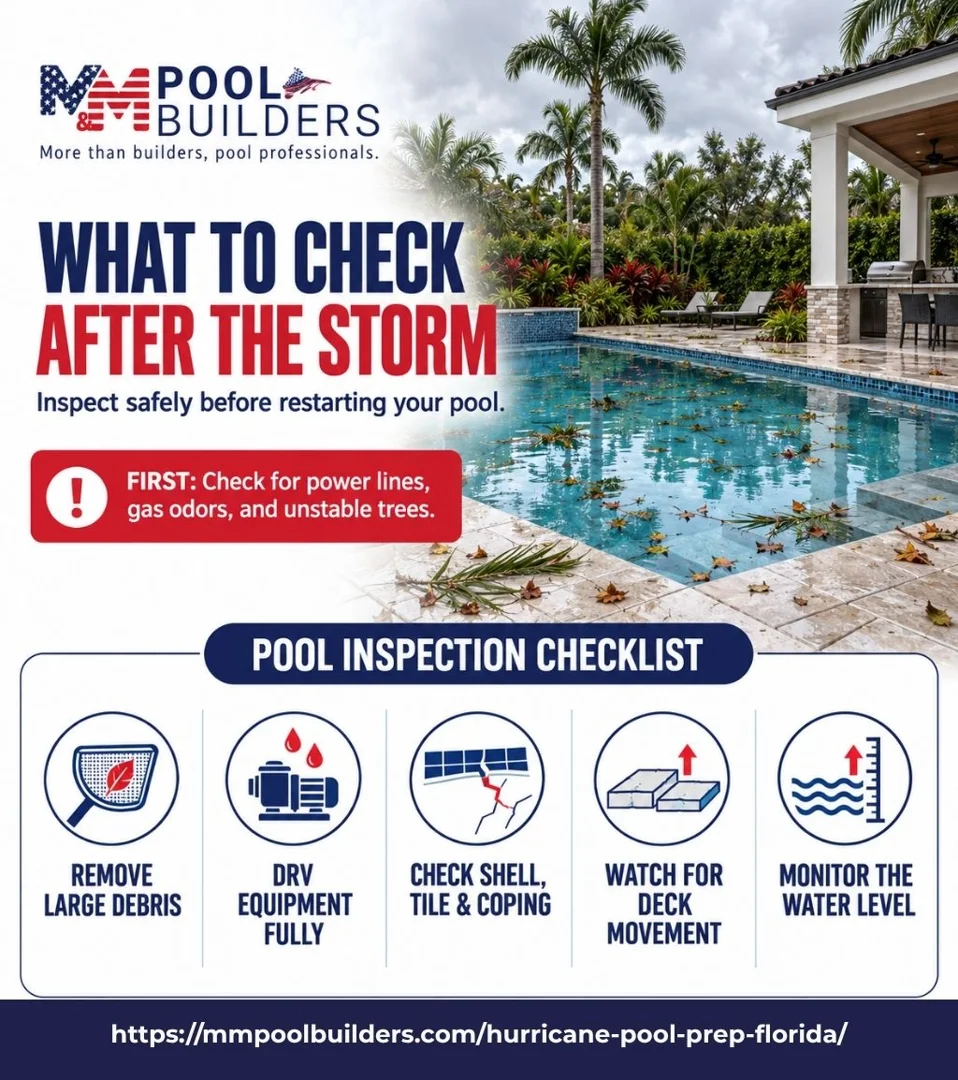
Several components benefit from a professional builder’s inspection:
- Cracking in the shell, to determine whether it involves surface crazing or structural shifting
- Tile or coping separating at the bond beam, which indicates soil movement
- Deck heave or settlement along the immediate pool deck edge
- A water level dropping faster than standard evaporation, which points to an open valve or a broken line
- Screen, pergola, and barrier damage, particularly concerning how securely the safety gates latch
Frequently Asked Questions
Should I Drain My Pool Ahead of a Hurricane?
Leaving the pool full serves as the best strategy. The water weight holds the shell against the pressure of a rising water table, maintaining structural integrity. Draining the pool requires a licensed contractor with specific insurance, making it an action best avoided ahead of a storm.
How Do I Know if My Pool Has a Hydrostatic Relief Valve?
This specific valve sits under the main drain cover at the deepest point. Checking the component requires accessing the drain directly, which makes it a standard part of a professional annual inspection.
Can I Put Patio Furniture in the Pool?
Storing furniture indoors provides the safest option, protecting the pool finish from metal stains and keeping upholstery safe from pool chemicals. The Florida Swimming Pool Association permits gently placing furniture in the pool as an alternative storage method, advising homeowners to take special care around the interior finish.
Do I Need to Cover the Pool?
Standard covers handle daily wear, while hurricane winds require different structural tolerances. High winds frequently tear standard covers loose, pulling anchors and deck fittings along with them. Leaving the pool entirely open serves as the standard professional recommendation.
What About the Spa?
Treat an integrated spa as part of the primary pool. It requires the same water chemistry, the identical power-down procedure, and similar debris removal afterward. A spa utilizing a separate heater needs the gas shut off at the source.
My Screen Enclosure Is Newer. Does It Still Need Venting?
Enclosures built to current wind requirements handle significant weather events well. Creating a path for wind to exit reduces the overall structural load, which makes the venting recommendation applicable for structures of any age.
Talk to M&M Pool Builders About Your Backyard
M&M Pool Builders operates as a family-owned company in Boca Raton, building custom pools, summer kitchens, pergolas, retractable screens, and turf installations across Palm Beach County and beyond. Having one team handle every element allows us to look at your entire backyard as a cohesive system. You can see completed work in our projects and how we run a build in our process.
When you get in touch, please share roughly when the pool was built, if the interior has been resurfaced, and where your equipment pad sits relative to the rest of the yard. Those three answers provide the foundational details our team needs to begin evaluating your outdoor space.
Schedule a consultation to walk through your backyard.
Marcus Moreira
Marcus Moreira is the co-founder and driving force behind M&M Pool Builders, Boca Raton's trusted name in custom pool construction and luxury outdoor living. Alongside his partner Marina, Marcus has spent over 10 years delivering exceptional craftsmanship — from resort-style pools to summer kitchens and pergolas — all backed by a free 3D design consultation and a 10-week build promise. His hands-on, family-first approach has made M&M a top-rated contractor across South Florida.
Recent Articles
How to Design a Patio That Connects Your Pool, Kitchen, and Pergola
Artificial Turf vs. Natural Grass in South Florida: Installation Time & Quality Comparison